









TL;DR: A strong visual brand identity pays you back through more sales, higher prices, and easier trust, and you can do the math on it. This guide covers the formula, real costs, honest timelines, the numbers to track, and when it’s not worth it.
What Does a Strong Visual Brand Identity Really Return?
Most articles on this topic mix things up. They say “branding” pays off, then quietly lump in your messaging, ads, loyalty, and company culture. But that’s not what you buy when you order a logo or a rebrand.
The return on your visual identity is narrower and easier to measure. It’s the payoff from the design system itself:
- Your logo
- Your colors
- Your fonts
- Your image style
That difference matters because the visual part does real work. Stanford research found that about 94% of first impressions are based on design. In other words, your look earns trust before anyone reads a word. So the real question isn’t “does branding work?” It’s “how much does this design spend return, and how do I prove it?”
Let’s start with the math.
How Do You Calculate Brand Identity Design ROI?

The formula is simple:
Brand ROI = (Revenue gain from branding − Branding cost) ÷ Branding cost, shown as a percentage.
The tricky part isn’t the equation. It’s getting honest numbers on both sides.
Here’s how to run it in four steps:
- Set your cost. Add up everything you spent on the visual identity work.
- Measure the gain. Track the revenue lift after launch, using a baseline (more on this below).
- Run the formula. Subtract cost from gain, then divide by cost.
- Find your payback. Divide the cost by the monthly gain to see how fast it pays for itself.
A quick example. Say your business makes $400,000 a year. You spend $8,000 on a brand refresh — new logo, colors, fonts, and templates.
After launch, your landing-page sales rate goes up 12%. That adds about $48,000 over the next year.
- Revenue gain: $48,000
- Cost: $8,000
- Brand ROI = ($48,000 − $8,000) ÷ $8,000 = 500%
- Payback time ≈ 2 months
These are example numbers, not a promise. Your lift depends on where you start.
But the point holds: you can’t claim a return without a real gain and a real cost. That cost is where most people get stuck. So let’s look at what a visual identity actually costs.
What Do Graphic Design Services Cost?
You can’t measure a return without knowing what you spent. Here’s how the main graphic design services break down in 2026. The ranges mix published prices with indicative industry figures:
| Option | Typical cost | Best for |
| DIY tools (Canva, etc.) | Free–low (indicative) | Very early, no budget yet |
| Freelancer | ~$20–$150/hr | One-off jobs |
| Agency project | $1,000–$2,000+ to start; full branding $5,000–$20,000 | Big one-time rebrands |
| In-house designer | ~$42,000–$65,000/yr | High, steady volume |
| Graphic design subscription | $499–$1,497/mo | Ongoing, steady output |
Each option has a hidden cost:
- DIY templates are shared by thousands of people, so your brand can look like a rival’s.
- Agencies do deep work but bill in big, uneven chunks.
- Freelancers swing in quality and availability.
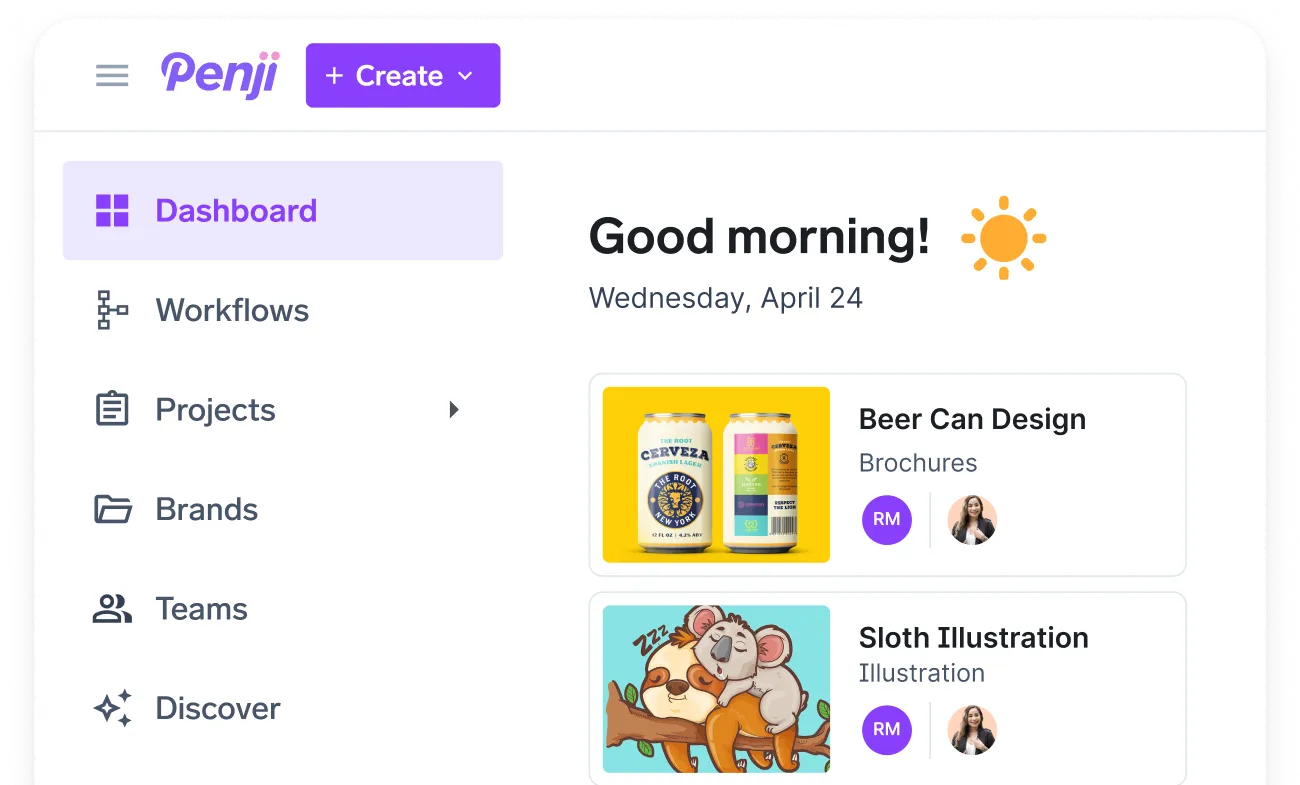
If you need more than three or four projects a month, a flat-rate graphic design subscription often pays for itself. This is where a design-as-a-service model fits. Services like Penji charge one set monthly fee starting around $499 for unlimited requests and revisions, with work back in 24–48 hours.
That steady price helps your math, too. A fixed cost is far easier to measure against than a pile of surprise invoices. For a full breakdown, see how much professional graphic design costs in 2026.
Now you have both sides of the equation. Next, you need to prove the design — not something else — caused the lift.
How Do You Know the Design Caused the Lift?
This is the question most guides skip. And it’s the hard one, because sales move for lots of reasons.
Here’s how to give the design fair credit:
- Set a baseline. Write down your sales rate, order value, and branded searches before launch. Compare the same window after.
- Run an A/B test. Show the new look against the old one on split traffic. This is the cleanest proof.
- Use a holdout. Keep one channel or region on the old look for a while as a control.
- Watch branded search. A stronger look usually lifts people searching your name directly. That’s hard to fake.
Watch the order of signals, too:
- Quick signals move first: clicks, time on page, recall.
- Slow signals confirm it later: revenue, higher prices, repeat buyers.
Once you can prove the lift, the next question is how long you should wait to see it.
How Long Until It Pays Off?
Be careful with anyone promising instant results. The return is real, but it rarely shows up overnight.
Here’s a realistic timeline:
| Timeframe | What you’ll see |
| 30 days | Early signs only: clicks, engagement, gut-check feedback |
| 90 days | First moves in sales rate and branded search |
| 6–12 months | The honest window for real revenue payback |
Your stage changes the math, too:
- New startup: The payoff is credibility. You look like a real company to investors and first buyers.
- Growing a small business: Your biggest lever. Small sales gains stack up as traffic grows.
- Established rebrand: The riskiest. You’re spending against a look people already know.
B2B and B2C differ as well. B2B payback shows up in longer sales cycles and trust. B2C shows up faster in clicks and shelf or feed appeal.
That risk for established brands is worth a closer look, because not every spend pays off.
When Is It Not Worth It?
An honest answer builds more trust than constant hype. Hold off when:
- You already have a strong, known look. Changing it can erase value. In 2010, Gap swapped its famous logo and reversed it within about a week after backlash.
- You have no baseline numbers. Without pre-numbers, you can never prove a return. Fix your tracking first.
- You’re changing it for taste, not results. Tropicana’s 2009 packaging redesign was tied to a sharp sales drop before the company switched back.
Which Numbers Prove Your Brand Identity Design Is Working?
Track these together, not one at a time:
- Sales rate: the most direct money signal.
- Average order value: Does a stronger look support higher prices?
- Price premium: Are people paying more without pushback?
- Brand recall: Can people describe you after seeing you once?
- Branded searches: Are more people searching your name?
- Time on page: Are visitors staying and looking around?
Why consistency multiplies your return
Here’s the quiet factor that decides your payoff: consistency. Consistent branding across channels is linked to revenue gains of about 23–33%. More than two-thirds of businesses say consistency helped grow revenue by 10% or more.
But here’s the catch. An inconsistent look cancels the return. A great logo used five different ways sends the same “messy” signal as a bad one.
That’s why a system beats a pile of one-off files. Penji’s Brand Profiles and dedicated design teams keep every asset on-brand across requests, which is what actually unlocks that consistency boost instead of leaking it.
With the framework in hand, here are the questions people ask most.
Get a design package with unlimited graphic design
Try Penji risk-free for 30 days & get all the custom designs you need


Conclusion
A strong visual brand identity isn’t just a cost, it’s an investment you can measure. The businesses that win don’t argue about whether design matters. They set a baseline, price the work honestly, give the design fair credit, and check the numbers each quarter. Then they protect the consistency that makes the whole return possible.
If your plan depends on building and keeping a consistent look across many touchpoints, that’s exactly what a design-as-a-service model is built for.
Explore Penji’s graphic design subscription plans or book a quick demo to see how dedicated designers and Brand Profiles keep every asset on-brand with 24–48 hour turnarounds, set pricing, and no contract.
Frequently Asked Questions
Use (revenue gain − cost) ÷ cost. The trick is getting an honest revenue gain from a baseline comparison and a complete cost figure.
Expect early signs in 30–90 days and real revenue payback over 6–12 months. Anything faster is a bonus.
Lock your baselines before launch, run A/B landing pages, and watch your branded searches. A/B testing gives the cleanest proof.
Full branding packages are about $5,000-20,000, and freelancers charge about $20-150/hr. A graphic design subscription runs $499–$1,497/month for ongoing work.
When you already have a strong, known look, no baseline numbers to measure against, or you’re changing things for taste instead of results.
About the author

Je Ann Bacalso
Je Ann is a creative content writer who crafts engaging, SEO-friendly articles and web copy. With a passion for storytelling and a sharp eye for detail, she delivers clear, compelling content that connects with readers.