









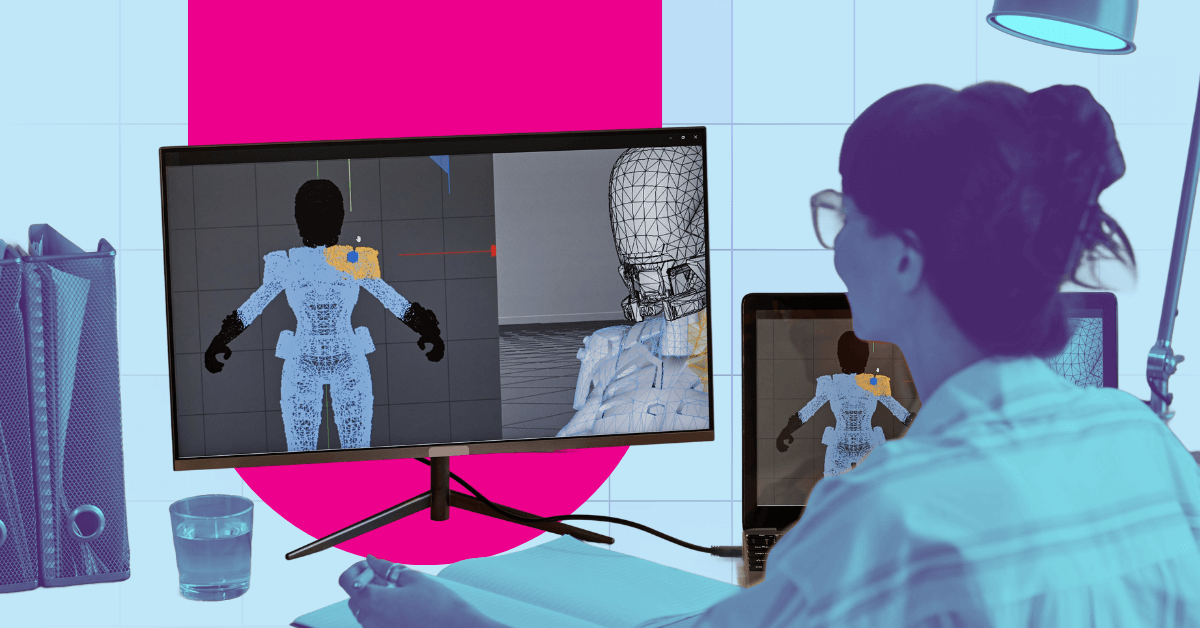
TL;DR: The best 3D animation software in 2026 depends on your skill level and budget. Blender is free and surprisingly powerful. Maya leads professional studios. And if you’d rather skip the software entirely, Penji’s designers handle animation for you.
The best 3D animation software gives businesses and creators the tools to build moving visuals that capture attention, explain complex ideas, and strengthen brand identity.
Top options in 2026 include Autodesk Maya for professional production, Blender for free and open-source work, Cinema 4D for beginners and motion graphics, Houdini for advanced simulations, Cascadeur for game-focused character animation, and Autodesk 3ds Max for modeling-heavy workflows.
A few years ago, getting into 3D animation meant either paying for expensive software or spending months just figuring out the interface. That’s changed. The tools have matured, pricing has gotten more accessible, and some of the best options out there are now free.
What hasn’t changed is how much work it still takes to actually produce good animation.
Knowing which software fits your needs is the first step. Here’s a breakdown of the best 3D animation software available in 2026, including what each one does well and what it costs.
Why 3D Animation Still Matters for Businesses
Before getting into the tools, it’s worth understanding why any of this matters for brands and marketers.
The global 3D animation software market was valued at $16.4 billion in 2025 and is projected to reach $36.8 billion by 2034, driven by demand in gaming, advertising, and real-time content creation.
This isn’t just a production trend. It’s a signal that businesses across every industry are investing in more dynamic visual communication.
Good animation attracts audience attention in ways static design can’t. It helps brands explain products, build emotional connection, and stand out on social media where visual noise is constant.
For companies that need ongoing animated illustrations or motion graphics services, the question isn’t whether to invest in animation. It’s how.
1. Autodesk Maya
Best for: Professional studios, blockbuster production, character animation
Maya is the industry standard. It has powered some of the biggest productions in film and television history, and its toolset reflects that. Modeling, rigging, simulation, and rendering are all covered at a level that few other tools match.
The Arnold renderer is bundled with every subscription, which matters for studios that need photorealistic output without paying for a separate renderer.
The AI-powered tools added in recent versions let animators automate repetitive rigging tasks, and Bifrost handles complex simulations like explosions and fluid effects inside a visual node-based environment. Maya also supports OpenUSD, making it easier to collaborate across large pipelines.
The tradeoff is price and complexity. Maya has a steep learning curve that takes real time to manage. For small teams or solo creators, the investment may not be justified.
2. Blender
Best for: Independent animators, video games, animated ads, and anyone working with a tight budget
Blender remains the most impressive free software in the 3D space. It’s open-source, actively developed, and capable of handling full production pipelines.
The rigging system lets animators define skeletal structures down to individual limb mobility. The sculpting tools rival paid software. Motion capture integration is supported. It handles both 2D and 3D work.
The community around Blender has grown significantly, which means tutorials, add-ons, and community support are easier to find than ever. Major studios have started using Blender as part of their production pipeline, which says a lot about where the tool now stands.
3. Autodesk 3ds Max
Best for: 3D modeling, architectural visualization, interior and exterior design
3ds Max shares DNA with Maya but leans toward modeling and visualization rather than character animation.
The interface tends to be more approachable for new users, and the tools for creating architectural spaces, product renders, and environmental design are particularly strong.
It supports particle and light simulation, cloth physics, and motion paths that make it easy to preview object movement in real time.
For teams that primarily need design visualization alongside animation, 3ds Max is worth.
4. Cascadeur
Best for: Video game developers, physics-based character animation
Cascadeur takes a different approach to animation. Rather than relying purely on keyframing, it uses physics principles to generate realistic movement, which means animators can get believable results faster.
The recent 2025.3 update introduced full Quadruped support for AutoPosing and Quick Rigging, expanding its usefulness beyond biped characters.
It integrates well into existing pipelines, which makes it a viable add-on tool rather than a full replacement for something like Maya.
The active Discord community keeps users connected to developers directly, which helps with troubleshooting and staying current on updates.
5. Cinema 4D
Best for: Beginners, motion graphics, broadcast design
Cinema 4D is built for accessibility without sacrificing quality. It’s the software that motion designers consistently reach for when the priority is speed and a clean workflow.
The learning curve is minimal compared to Maya or Houdini, and keyframing any object, material, or parameter is intuitive from the start. Tag expressions, effectors, and a full expression editor are all included.
Cinema 4D 2026.0 is compatible with Windows 10+ and macOS 14.0+, with subscriptions currently priced at $109/month or $839/year. It’s not the deepest tool for complex character work, but for brands that need polished motion graphics and broadcast-quality 3D, it consistently delivers.
6. Houdini
Best for: Advanced VFX, simulations, large-scale crowd effects, game development
Houdini is used by Disney, Pixar, and major game studios for a reason. It handles crowd simulations, fluid dynamics, fire, destruction, and particle systems at a level that other software simply can’t match.
The procedural workflow gives artists exceptional control over complex effects without having to rebuild everything from scratch when something changes.
There’s a well-documented learning curve. Houdini rewards artists who are willing to think technically.
But for studios working on high-complexity production, it’s one of the most powerful tools available.
What to Think About Before Choosing
The right choice comes down to a few things. Budget matters, but so does workflow fit. Maya and Houdini are worth the cost for studios with full pipelines. Blender is genuinely production-ready and costs nothing.
Cinema 4D makes sense when speed and ease of use are the priority. Cascadeur fills a specific need in game animation that other tools don’t address as cleanly.
It’s also worth asking whether building an in-house animation capability is actually the right move. Software takes time to learn, and time has a real cost.
For businesses that need consistent, professional animation without taking on that learning curve, there’s another option worth considering.
Conclusion
The 3D animation software landscape in 2026 offers more choice than ever, from free tools like Blender to full professional suites like Maya and Houdini. Each one serves a different kind of creator. The key is matching the tool to the actual work.
If the goal is producing animation for a business, without managing software licenses or spending months developing technical skills, Penji’s design team handles that for you.
Unlimited requests, dedicated designers, and turnaround in 24 to 48 hours. See Penji’s motion graphics portfolio and browse plans to get started.
Frequently Asked Questions
What is the best free 3D animation software in 2026?
Blender is the strongest free option available. It’s open-source, handles full 3D production pipelines including modeling, rigging, and rendering, and has been adopted by professional studios alongside independent animators. The active development community means it continues to improve, and the library of tutorials and community support is now comparable to paid tools.
Is 3D animation software hard to learn for beginners?
It depends on the tool. Cinema 4D is specifically designed to minimize the learning curve and lets beginners get into production quickly. Blender has a steeper initial curve but an enormous community of tutorials. Maya and Houdini are both powerful but require a significant time investment before producing professional-quality work. For businesses that need animation without the learning time, working with a service like Penji’s 3D animation services is a practical alternative.
How much does professional 3D animation software cost in 2026?
Costs vary widely. Blender and Cascadeur’s Basic plan are free. Cinema 4D runs $839/year. Autodesk Maya is $1,945/year for a full commercial license, though a Maya Indie license is available at $305/year for qualifying independent creators. Houdini ranges from free to $4,495/year depending on the plan. Most professional tools offer free trials before purchase.
Can businesses use 3D animation without learning software?
Yes. Subscription design services like Penji include graphic design services and animation work handled by dedicated professional designers. For businesses that need logos, animated brand assets, social media visuals, and more, this approach delivers professional results without the software investment or learning time.