








TL;DR: Professional design services are a silent salesperson that guides users to desired actions through smart visual hierarchy, fast load times, and seamless user experiences. Investing in professional design directly removes cognitive friction, which can increase your website’s conversion rate by up to 400%.
You want more revenue. You pour money into ads and content. But when visitors land on your site, they leave. Design is often misunderstood as purely aesthetic. It is actually the mechanical engine behind your website’s performance.
Professional design services systematically remove friction and align the visual experience to the user intent. When you get the mechanics of your layout right, users don’t think, they click.
Now let’s unpack the specific design levers that drive measurable revenue growth and how you can apply them today.
Why do professional design services drive higher conversion rates?
When a visitor lands on your page, they evaluate your credibility in milliseconds. If your layout is cluttered, your fonts are hard to read, or your navigation is confusing, that visitor will bounce.
Conversion-focused design is the strategic use of visual and functional elements to maximize the percentage of users who complete a specific business objective. It minimizes cognitive friction. It guides the eye.
Let’s look at exactly what kind of financial return you can expect when you get this right.
What is the financial impact of professional design services?

According to Forrester Research, a well-designed user interface can increase your website’s conversion rate by up to 200%. Furthermore, advanced UX optimizations can yield conversion rates up to 400%.
- Metric: Conversion Rate
- Key Driver: Cognitive ease and visual trust
- Indicative Impact: 200% to 400% lift from baseline
- Primary Levers: Page speed, mobile responsiveness, call-to-action (CTA) clarity, and visual hierarchy
But how do you choose between doing it yourself and hiring experts? Let’s compare your options.
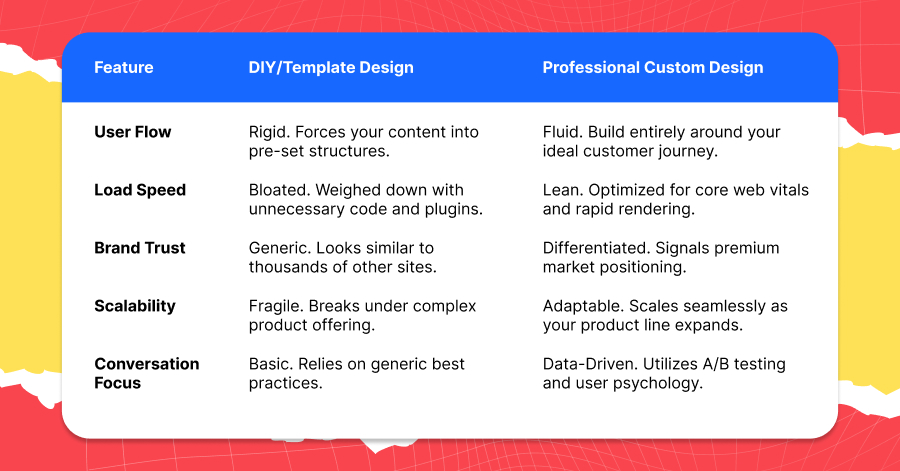
How do DIY templates compare with custom designs?
Many companies use pre-made templates to save costs. It feels like a quick fix but it is ultimately limiting.
Templates are great for early stage validation, but they quickly become a growth bottleneck. The digital space is created and tailored by professionals to meet the needs of your specific audience.
Upgrading your visual presence requires an investment. Let’s evaluate if your business is ready to take that step.
If you want to understand how to select an agency or service that fits your specific scaling needs, read our guide on How to Choose the Right Design Partner.
When should you invest in design-as-a-service?

Delaying an upgrade costs you customers daily. If you’re more interested in revenue growth in the long run than in short-term savings, go custom design.
Pros of professional design:
- Real improvements in conversion rate and lead quality.
- Improved brand equity and immediate trust building.
- Lower bounce rates & improve session duration.
Cons of Professional design:
- More upfront money than templates.
- Needs time for user research, wireframing and testing.
Design makeover? Look for these common signs:
- Your website traffic is growing but your revenue is not.
- You have a high bounce rate, consistently over 60%.
- Users often mention that navigation is confusing.
- You are launching a high-ticket product.
- Your current design does not reflect your current brand positioning.
You don’t always need to hire an expensive traditional agency. Subscription-based platforms allow you to scale your design needs predictably. Let’s look at how subscription models give you a competitive advantage.
Why are unlimited design services the smart choice?
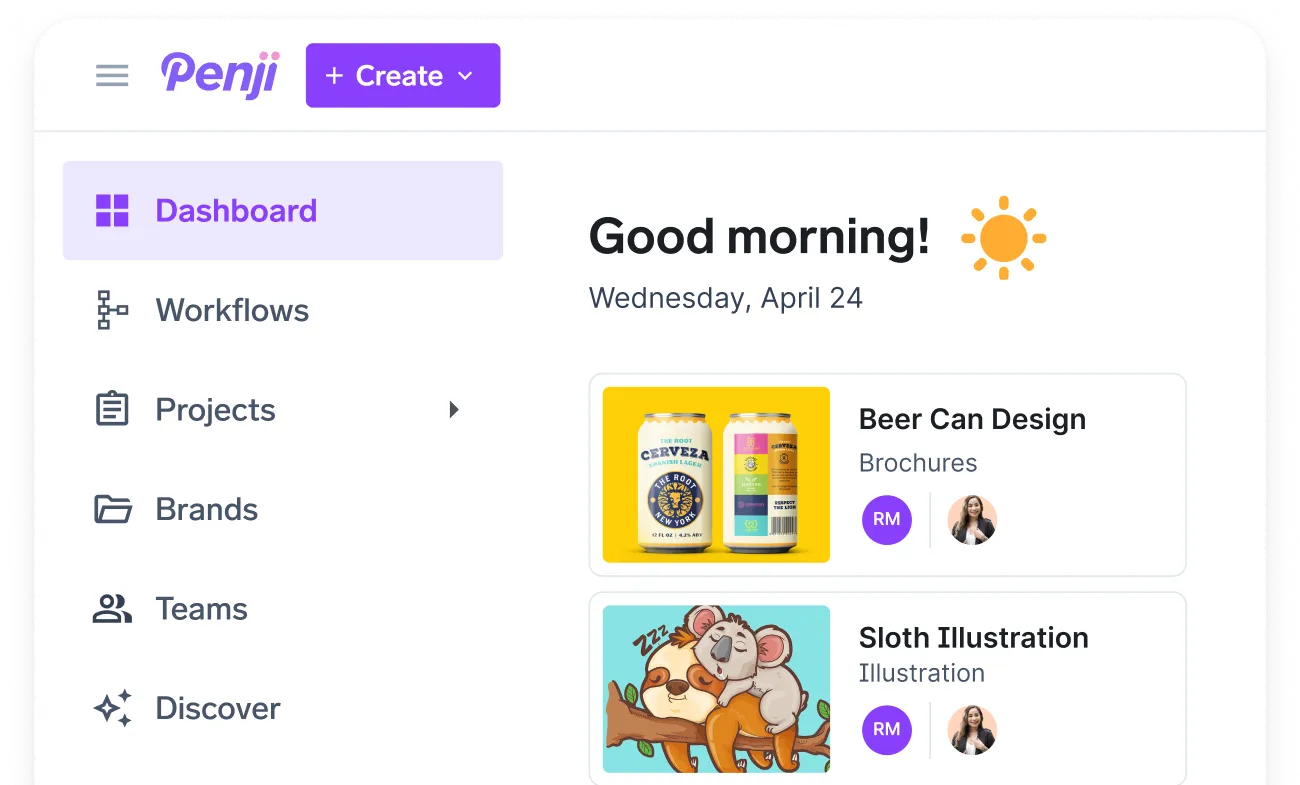
Like a creative agency — but 70% more affordable. Platforms like Penji provide unlimited design services for a flat monthly rate. You get fast turnarounds, top 1% talent, and unlimited revisions. You continuously test and iterate. Your conversion rates keep climbing.
Now that you know how to source your design, here is exactly how to fix your user experience.
Get a design package with unlimited graphic design
Try Penji risk-free for 30 days & get unlimited custom designs


How do you implement a conversion-focused design?
If you want to turn your website into a high-converting asset, address the core mechanical levers of design. Follow this step-by-step process.
Step 1: Optimize your page load speed
Page load time is the single most measurable design decision affecting conversion. Google PageSpeed Insights heavily weights visual stability and rendering speed. Compress all image assets. Eliminate render-blocking code. Utilize a Content Delivery Network (CDN).
Industry research has shown that website speed affects conversion rates at a quantifiable rate of about 7% lost for every one second increase in load time.
Faster.
Step 2: Establish a strict visual hierarchy
Visual hierarchy dictates where the user looks first, second, and third. You must make the most important element on the page look like the most important element.
Use an F-pattern or Z-pattern layout. Increase the contrast of your value proposition. Minimize secondary visual clutter.
Focused.
Step 3: Make your call-to-action (CTA) clear
Your CTA is the income gateway. It’s supposed to be completely different from the surrounding content.
Mix up your main CTA buttons with contrasting colors. Make the button text action-oriented. Ensure only one primary CTA exists above the fold.
Clickable.
Step 4: Streamline forms to reduce friction
Every additional form field reduces your conversion rate. Research from the Baymard Institute consistently shows that complex forms are primary conversion killers.
Reduce checkout form fields from the average 14 down to a maximum of 8. Remove optional fields entirely.
Simple.
Step 5: Implement mobile-first responsiveness
Over 65% of global website traffic comes from mobile devices. If your site simply shrinks a desktop view down to a mobile screen, users will leave.
Design for thumb zones. Make sure all interactive elements are a minimum of 44×44 pixels to allow for touch targets on iOS and Android devices.
Optimised.
These mechanical levers are universal. Next we will look at their use in specific industries.
What graphic design services are needed in various industries

The conversion design doesn’t seem to be the same in all industries. Match your visual style to the psychological conventions of your industry.
- E-Commerce: Focus on high-fidelity product images and persistent cart visibility. Trust badges right next to the “Add to Cart” button make it easy for people to complete the transaction.
- B2B SaaS: Usually the goal is to get a software demo or sign up for a free trial. Simplify complex technical features with intuitive icons, interactive product tours, and dashboard previews.
- Healthcare: compliance and trust are critical. Authority is built with clean designs, prominent human faces, clear contact information, and accessible typography.
Now that you’ve got your industry specifics in mind, it’s time to put your strategy into action.
Turn your traffic into revenue today
Design is a thoughtful, data-informed way of reducing user friction. Focusing on speed, visual hierarchy, mobile responsiveness, and clear CTAs, you’re directly impacting purchasing decisions.
Stop losing valuable traffic to poor user experiences. Penji provides on-demand graphic design services to help you continuously test and optimize your digital presence.
Ready to transform your user experience and scale your revenue? Start your risk-free trial with Penji today. Let our expert designers build the high-converting assets your business deserves. Invest in professional design services and watch your business grow.
Frequently Asked Questions
Conversion rate is the percentage of people that visit your website and do something you want them to do like buy something or fill out a lead form. How essential is it? That’s because it measures how well your website turns traffic into revenue.
Professional design makes information logically structured, fast loading and intuitive navigation. This reduces cognitive load and helps users find what they need and do what they want without frustration.
The most important factors are fast loading speeds, mobile responsiveness, clear Call-to-Action (CTA) buttons, intuitive visual hierarchy and strategically placed social proof.
Establish baseline metrics before and after a redesign to measure design ROI. Look at changes in overall conversion rate, bounce rate, average session duration, and customer acquisition cost (CAC).
Most web traffic is mobile traffic, so a site that isn’t responsive is an immediate frustration for users. And mobile-optimized designs help ensure buttons are clickable, text is readable and you don’t lose sales outright.
About the author

Je Ann Bacalso
Je Ann is a creative content writer who crafts engaging, SEO-friendly articles and web copy. With a passion for storytelling and a sharp eye for detail, she delivers clear, compelling content that connects with readers.
Table of Contents
- Why do professional design services drive higher conversion rates?
- What is the financial impact of professional design services?
- How do DIY templates compare with custom designs?
- When should you invest in design-as-a-service?
- Why are unlimited design services the smart choice?
- How do you implement a conversion-focused design?
- What graphic design services are needed in various industries
- Turn your traffic into revenue today
- Frequently Asked Questions