









TL;DR: To effectively manage design revisions, it’s crucial to set clear boundaries and limit feedback rounds from the start. Centralize all communication and track requests meticulously to prevent scope creep and keep projects on track.
Without a clear process to handle feedback, you risk watching your profit margins shrink and your project timelines stretch forever. Managing design revisions effectively is the secret to taking control of your workflow and keeping clients happy.
This guide gives you the exact workflows, tools, and communication strategies you need. By using these systems, you can maintain a high-velocity output and ensure your agency or freelance business scales effortlessly.
But before you can fix your process, you need to understand what actually causes these endless feedback loops in the first place.
What Drives the Revision Cycle?

Feedback is a normal part of the creative process. However, the way you collect that feedback decides whether a project stays profitable or turns into a nightmare.
A true revision is a small adjustment to an existing concept based on the original brief. It is never a completely new concept or a brand-new deliverable. Winning the battle against scope creep starts by clearly separating a simple “tweak” from a “new request.”
Industry data shows that creative teams lose up to 30% of their billable hours simply hunting down unstructured feedback across Slack, email, and Zoom. When you offer professional graphic design services, you must control the environment where clients leave their comments.
When you look at the numbers, the difference between chaos and control becomes incredibly clear.
The Cost of Unstructured vs. Structured Feedback
Building a solid framework takes a little effort upfront, but it pays off massively in speed and predictability. Here is a breakdown of how the two environments compare:
| Metric | Unstructured Feedback | Structured Feedback |
| Channels | Email, Slack, WhatsApp | Figma, Penji, Asana |
| Clarity | Vague (“make it pop”) | Objective and pinned to elements |
| Scope Creep | Very High | Low |
| Average Rounds | 5 to 7 rounds | 2 to 3 rounds |
| Output Impact | Severe bottlenecks | Predictable delivery |
You lose control over your project’s timeline when you let clients choose how to give you feedback, whether it’s through a spontaneous Slack message or a late-night email. An unstructured process leads to notes that are scattered and often contradictory, making them hard to keep track of and use effectively.
On the other hand, a structured feedback system forces clients to put their thoughts into clear, actionable requests. You get rid of confusion and cut down on endless back-and-forth by making feedback consistent in terms of where and how it is given. This is exactly why a lot of creative teams are using the graphic design subscription model, which makes these standard interactions a key part of the service.
This structure is a great starting point, but real mastery comes from being able to change your approach to fit the needs of each client. Not every client or project is the same, and a process that doesn’t allow for any changes can also cause problems.
Industry-Specific Revision Considerations
Not all feedback is equally important. You should change how you do things depending on the rules and realities of your client’s field:
- Changes to SaaS and product design usually have an effect on user experience (UX).You need data from tools like Hotjar to validate changes and push back on subjective requests.
- Healthcare and Finance: Compliance is more important than aesthetics. Version control is a legal requirement, making design as a service solutions highly valuable for keeping records clean.
- E-commerce: Speed is everything. Ad creative revisions must happen within 48 hours to match consumer trends.
Now that you know what you are up against, let’s look at the exact steps you can take to take back control of your workflow.
4 Steps for Managing Design Revisions Like a Pro
You will never eliminate feedback completely, but you can build a rigid container for it. Follow this four-step checklist to keep your projects moving fast.
1. Establish Pre-Contract Boundaries
Stop scope creep before the kickoff call. Your contract must define exactly what a revision looks like. Providers of unlimited graphic design services excel at this by setting clear rules from day one.
Boundary Checklist:
- Define the exact number of included revision rounds.
- Set a strict turnaround time for client feedback (e.g., 48 hours).
- State the specific hourly rate for out-of-scope requests.
- Clarify that new concepts require a brand-new project brief.
2. Implement the Three-Round Framework
Transform your revision process by giving every round a distinct purpose. This strategic approach stops clients from asking for layout changes that would cause problems right before final delivery, which keeps your project on track and within scope.
- Round 1 (Structure): Spend this first stage completely on the basic parts of the design. Pay attention to the main idea, layout, and structure. Ask your client big-picture questions like, “Does this design fit with your brand’s vision and the main goals of the project?” This is the time for big changes, not little ones.
- Round 2 (Details): After the structure is approved, focus on making the small details better. This round is for getting the details of typography, color schemes, and the exact placement of text and other elements just right. Make sure that every detail is perfect and follows the brand’s rules.
- Round 3 (Polish): Use the last round to make small changes to the look and add the finishing touches. This is the time to make small, quick changes, like fixing a typo or changing a color slightly. It’s not the time to add new ideas or completely change the layout.
3. Centralize All Communication
Stop chasing feedback through scattered email threads and forgotten Slack messages. To keep your projects moving forward, guide clients toward a single source of truth for all communication. This could be direct comments within a Figma file, a centralized Trello board, or a dedicated project management dashboard. By consolidating feedback, you ensure nothing gets lost and everyone stays aligned.
4. Deploy a Revision Log
Keep a simple tracker to document every requested change.
| Asset | Request | Date | Status |
| Homepage | Change CTA button to orange | Oct 12 | Resolved |
| Social Ad | Update logo sizing | Oct 14 | Pending |
The platform you build a solid process on is what makes it strong. Even the best-organized work can fall apart if you don’t have the right tools. This brings us to the most important part of your business: your tech stack.
Choosing the Right Tooling Stack

Your ability to scale depends on your technology. Traditional agencies often use scattered tools—Jira for tracking, Dropbox for files, and email for approvals. This fragmentation kills your momentum. Every time you switch apps to find a comment, your graphic design services suffer.
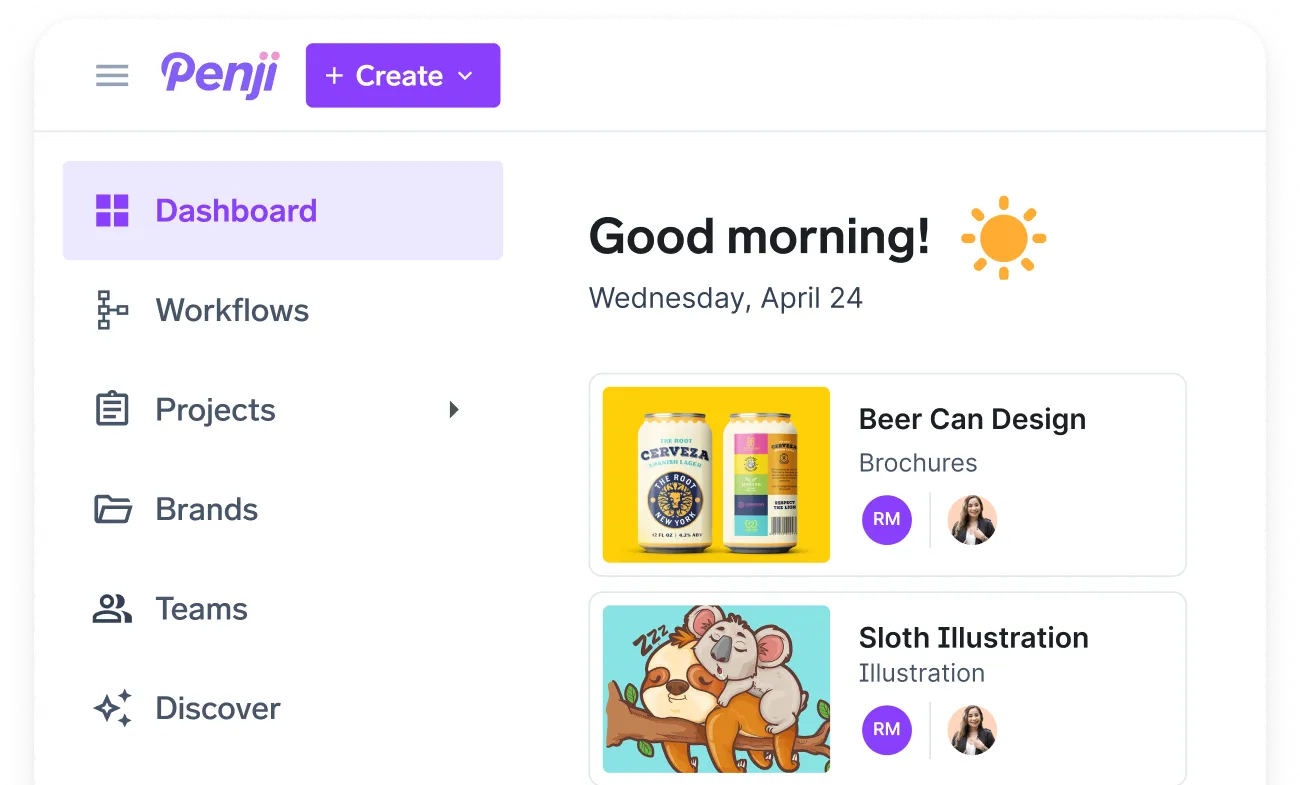
Conversely, productized platforms operate on a unified system. When you use a graphic design subscription like Penji, everything happens in one dashboard. Clients click directly on the design to leave pinpointed feedback. You execute the change and re-upload the file in the same window.
This model treats design as a service, removing friction and completely eliminating the “he said, she said” dynamic. High-volume teams rely on unlimited graphic design services specifically because the built-in tooling makes the feedback loop effortless.
It is time to ditch the endless email threads and step into the future of creative work.
Scale Your Creative Output Today

Setting boundaries and centralizing your communication stack does not stifle client input; it simply channels it into a predictable system. By assigning specific purposes to each feedback round, you protect your margins and deliver incredible work on time.
If tracking feedback across six different apps is slowing you down, it is time to upgrade your infrastructure. Penji provides an all-in-one platform featuring top-tier creatives, built-in feedback tools, and predictable flat-rate pricing.
Experience the future of design. Let our creatives pilot the ship while you focus on scaling your business. When it comes to managing design revisions, you deserve a system that works as hard as you do.
[Try Penji Today and Scale Effortlessly]
Boost your business with unlimited graphic design
Try Penji risk-free for 30 days and get all your design projects done













FAQs
For most projects, two to three structured rounds work best. Use the first round for broad concepts and the final rounds for detailed polishing.
Rely on your data. Point to your contract and revision log, and politely say: “We have finished the included revision rounds. To make these extra changes, we will need to open a new work order at our standard hourly rate.”
A revision modifies an existing asset based on the original brief. A new concept completely ignores the original brief and requires starting from scratch.
It eliminates context-switching. When you do not have to hunt through Slack to find instructions, you can execute changes immediately.
Figma and Adobe XD are great for canvas commenting. However, for a fully managed experience without per-hour billing, platforms like Penji offer the most efficient solution.
About the author

Je Ann Bacalso
Je Ann is a creative content writer who crafts engaging, SEO-friendly articles and web copy. With a passion for storytelling and a sharp eye for detail, she delivers clear, compelling content that connects with readers.