







TL;DR: Graphic design outsource means hiring external designers instead of building an in-house team. You have three real paths: freelancers, agencies, or unlimited design subscriptions. For ongoing, multi-channel work, a subscription model like Penji ($499/month, 24–48 hour turnaround) usually wins on cost, speed, and brand consistency. This guide breaks down the models, the true costs, and how to set up outsourcing the right way.
When you outsource graphic design, you stop carrying the full weight of design in-house. You tap external talent for logos, ad creative, social posts, and decks without the salary, the hiring cycle, or the management drag.
That matters because design demand keeps climbing while budgets stay tight. The question for most teams isn’t whether to outsource. It’s which model fits and how to avoid the common traps. Let’s start with a clean definition.
What does it mean to outsource graphic design services?

Outsourcing shifts design execution to a partner outside your payroll. You send a brief. They deliver finished files. You skip recruiting, benefits, software licenses, and idle-time costs.
This is sometimes called design as a service (DaaS). Instead of paying per project or per hour, you pay a flat fee for ongoing access to a design team.
The category covers a wide range of deliverables: logos, branding, social media graphics, ad creative, web and app design, infographics, packaging, and presentation decks. Almost any recurring visual need can move off your plate.
Now that the term is clear, here’s why teams actually make the switch.
How can outsourcing design services help your business?
The benefits are practical, not abstract. Here’s what you gain:
- Lower cost than hiring. A U.S. in-house graphic designer earns a median of $61,300 per year, per the Bureau of Labor Statistics (May 2024). Add benefits, software, and overhead, and the real number climbs higher.
- Speed. Subscription services typically deliver standard work in 24–48 hours. No queue backlog from a single overloaded employee.
- Scalability. Need a logo this week and ten ad variations next week? You flex up and down without rehiring.
- Brand consistency. A dedicated team learns your colors, fonts, and tone over time — so your brand looks the same across every channel.
- Freed-up internal focus. Your marketers stop sourcing designers and writing endless revision notes. They get back to strategy.
Call-out: A common rule of thumb if you produce 10 or more designs per month, a flat-rate subscription usually beats per-project pricing.
These gains only show up if you pick the right model. Here are your options.
What are the different ways to outsource graphic design?
You have four routes. Each fits a different stage, budget, and volume.
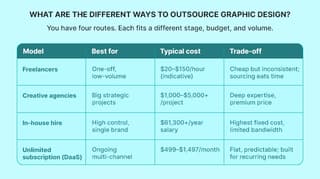
Freelancer rates above are indicative industry ranges and vary by location and experience.
If you’re weighing the two most common choices, this breakdown on a design subscription versus hiring freelancers covers the math in detail.
Picking a model is step one. Knowing when to outsource is step two.
When should you outsource graphic design (and when shouldn’t you)?
Outsourcing isn’t always the answer. Be honest about your situation.
Signs it’s time to outsource:
- Your internal team is stretched thin and writing briefs instead of doing strategy.
- You need more design than one person can produce across channels.
- You’re overspending on freelancers and still chasing deadlines.
When to think twice:
- Your design work is deeply strategic and needs constant in-room context.
- Your volume is very low — a few projects a year may not justify a subscription.
- You operate in a regulated niche where designers need heavy domain training.
For a deeper look at the tipping point, see the clearest signs it’s time to outsource your design.
Once you’ve decided, the setup process determines your results.
How do you outsource graphic design services step by step?
Follow these five steps to avoid the usual friction:
- Define your needs and volume. List deliverable types and monthly count. This tells you which model fits.
- Choose your model. Match volume and budget to the comparison table above.
- Write a brief that prevents revisions. Include the goal, audience, dimensions, brand assets, examples you like, and a hard deadline.
- Set up a revision workflow. Use one organized system for feedback — not scattered email threads.
- Confirm IP and source files in writing. Lock down ownership of final files and source files before work begins.
A clean process protects more than your timeline. It protects your brand.
How do you protect your brand and IP when you outsource graphic design services?
This is where teams get burned. Two risks stand out: ownership and confidentiality.
Always confirm in writing that you own the final designs and the editable source files. Without that clause, you may not legally control your own logo.
Confidentiality matters too. When you share brand assets, you want a secure, organized system — not files floating across inboxes.
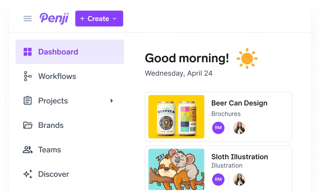
This is one area where the platform model helps. Penji, for example, uses an in-app system where you point, highlight, and annotate directly on a design, with all notes tracked in one place. Its designers are full-time employees across 20+ countries, not anonymous gig workers. That structure reduces both the revision chaos and the security gaps you get from juggling one-off freelancers.
Protecting your brand also means thinking ahead to how AI fits in.
Does outsourcing still make sense in 2026 with AI tools?

Yes, but the smart approach is hybrid.
AI is good at speed and iteration. It still has difficulty with brand nuance and creative judgment. Logos created in seconds sometimes don’t embody the true identity of a brand.
The strongest model right now is human-first, AI-enabled: real designers using AI to move faster while keeping creative control. You get the speed of automation and the judgment of a professional.
That balance is exactly what reliable outsource graphic design services are built to deliver in 2026.
A quick real-world example
A small e-commerce brand once waited three months on a freelancer for product banners. By the time the files arrived, the sale was over. The designs were fine — the timing killed the campaign.
A dedicated subscription team avoids that. One week it’s a logo, the next an infographic, the next a set of ads all delivered on a predictable schedule, all on-brand.
What’s the takeaway, and where do you go next?
Here’s the short version: graphic design outsourcing gives you professional output without the cost and overhead of a full-time hire. Freelancers fit small one-offs. Agencies fit big strategic projects. For steady, multi-channel volume, unlimited design services on a subscription give you the best mix of speed, cost, and consistency.
If your team is drowning in design requests and tired of unreliable freelancers, the next step is simple. See how Penji delivers unlimited, on-brand graphic design services for one flat monthly rate, with no contracts and a 30-day money-back guarantee.
Get a design package with unlimited graphic design
Try Penji risk-free for 30 days & get unlimited custom designs









👉 Schedule a demo today or watch the 2-minute walkthrough to get your first project moving in minutes. The fastest way to fix your design bottleneck is to outsource graphic design to a team built for it.
Frequently Asked Questions
Freelancers charge roughly $20–$150/hour (indicative). Agencies start around $1,000–$2,000 per project. Unlimited subscriptions run from about $499 to $1,497 per month.
Freelancers charge roughly $20–$150/hour (indicative). Agencies start around $1,000–$2,000 per project. Unlimited subscriptions run from about $499 to $1,497 per month.
Yes, as long as you work with reputable providers and confirm ownership of your final files and source files in writing before work starts.
Most subscription services deliver standard projects within 24–48 hours. Complex work like motion graphics or multi-page decks takes longer.
You should — but only if your agreement says so. Always confirm ownership of both final and editable source files upfront.
Yes. AI is fast but weak on brand nuance. A human-first, AI-enabled team gives you speed plus creative judgment.