








TL;DR: When every design request feels equally urgent, nothing moves fast enough. This post walks through a practical framework for ranking requests, setting expectations, and using unlimited graphic design services to keep output consistent without the chaos.
Prioritizing design requests starts with a clear tier system: urgent, revenue-critical items come first; time-sensitive campaign assets come second; and evergreen or low-stakes requests come third.
Pair this with a reliable unlimited graphic design services partner and a shared intake process, and backlogs stop building before they start.
Every design team knows the feeling. A Slack message comes in marked “urgent.” Then another. Then three more in an email thread.
By noon, everything is a priority, which means nothing really is.
According to Sprout Social’s 2025 Social Media Productivity Report, nearly two-thirds of marketing teams are bogged down by manual tasks, and unmanaged design queues are one of the biggest culprits.
Getting control of design requests isn’t just about staying organized. It’s about protecting the quality and speed of every piece of creative going out the door.
The right unlimited graphic design services partner makes the whole system run smoother. This guide walks through exactly how to build it.
Why Design Request Prioritization Breaks Down
Most teams don’t have a system. Requests arrive through Slack, email, verbal asks, and the occasional sticky note. Without a shared intake process, the loudest voice in the room tends to win, not the most important project.
Common reasons prioritization fails:
- No single channel for submitting requests
- No shared definition of what “urgent” actually means
- Designers context-switching between too many tasks at once
- Requestors setting their own priority levels without full context
- No visibility into what’s already sitting in the queue
The result is a backlog that grows faster than it gets cleared, and a design team that feels stretched even when the actual workload isn’t unreasonable.
A Simple Framework for Ranking Design Requests
A tiered prioritization model takes the guesswork out of deciding what gets done first.
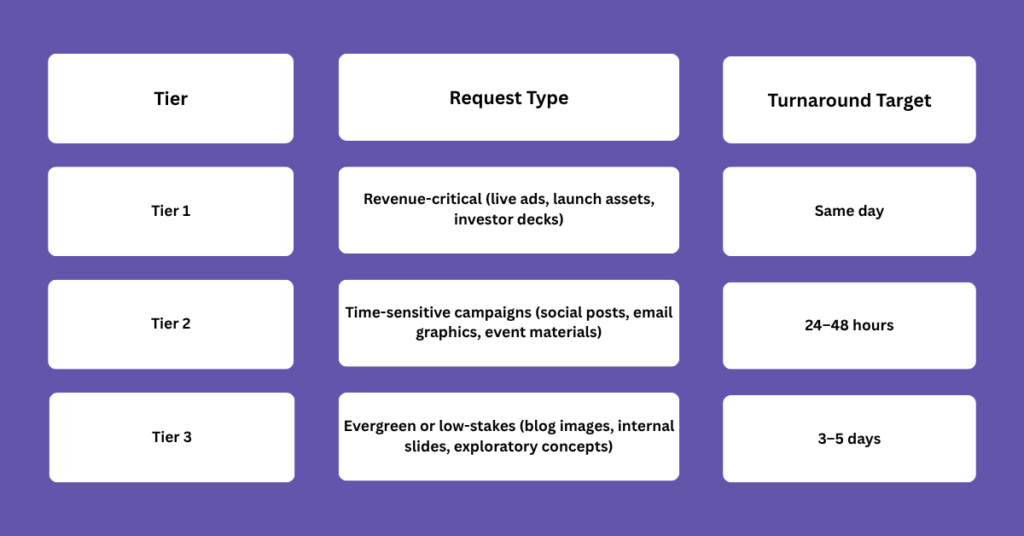
Apply this to every incoming request before assigning it. If requestors consistently try to label everything Tier 1, that’s a signal to revisit the criteria with the broader team.
How to Set Up a System That Actually Works
A clean intake process removes the guesswork from prioritization entirely. Here’s how to build one from scratch:
- Create a single intake channel. Whether it’s a project management tool, a shared form, or a design portal, all requests go through one place. No exceptions.
- Require key fields on every submission. Ask for: project name, deadline, business reason, assets needed, and final approver. This alone eliminates most back-and-forth.
- Define tier criteria in writing. Post it somewhere visible. When everyone agrees on what “urgent” means in advance, the arguments stop before they start.
- Run a daily queue review. Every morning, the design lead or project manager scans the queue, confirms priorities, and adjusts timelines. This keeps surprises from piling up.
- Communicate status back to requestors. A quick update that says “in queue, expected Thursday” does more for trust than silence followed by a rushed delivery.
- Build in a buffer. Reserve around 20% of weekly design capacity for true emergencies. That way, actual urgent requests don’t derail everything else.
Managing design requests at the subscription level follows this same logic. Penji’s project managers handle intake, prioritization, and status updates so the design work itself never gets disrupted.
Boost your business with unlimited graphic design
Try Penji risk-free for 30 days & get unlimited custom designs


What to Do When Everything Is Genuinely Urgent
Sometimes a product launch, a campaign deadline, and an investor meeting all land in the same week. When the queue is legitimately full, here’s how to handle it without burning the team out:
- Triage by downstream impact. If one project delays revenue or carries an external deadline that can’t move, it wins.
- Push back on internal deadlines. Not every “urgent” request has a real external constraint. Ask what happens if it ships 24 hours later. The answer is often “nothing significant.”
- Batch similar requests. If three people need social graphics with similar specs, one consolidated brief saves time across the board.
- Scale capacity temporarily. This is where on demand design services make a real difference. Rather than burning out an in-house team, teams using a graphic design subscription can absorb volume spikes without a hiring conversation. Penji’s on demand graphic design services are built exactly for this kind of situation.
Why Unlimited Graphic Design Services Make Prioritization Easier
A good prioritization system solves the organizational problem. But it doesn’t solve the capacity problem. If there are more legitimate Tier 1 and Tier 2 requests than a small team can handle, the system breaks down regardless of how well it’s structured.
That’s where unlimited graphic design services through Penji change the equation. Teams get access to design support for marketing teams without managing headcount, negotiating freelance rates, or waiting on agency availability.
Requests go in, work comes back, and the queue actually clears.
Penji operates as a true design as a service partner: one flat monthly rate, a dedicated designer who learns the brand, and turnaround times that hold up even during the busiest periods.
For a closer look at how that consistency works in practice, Penji’s quality process across every design request walks through the full submission-to-delivery workflow.
Here’s how the models compare:
| Model | Speed | Cost Predictability | Scalability |
| In-house designer | Medium | High fixed cost | Limited |
| Freelancer | Variable | Low (per-project) | Low |
| Graphic design services subscription | Fast (24–48 hrs) | Flat monthly rate | High |
| Agency | Slow | High project fees | Medium |
For teams managing sustained high volume, the graphic design services subscription model consistently outperforms freelance and agency arrangements on both speed and budget control.
The chaos of competing design requests rarely comes from bad intentions. It comes from systems that weren’t built to handle the volume.
A tiered framework, a clean intake process, and a reliable creative partner take most of the friction out of unlimited graphic design services workflows.
When the system runs well, design stops being the bottleneck and starts being the output.
See what Penji can do for your team. Browse plans and start submitting today.
Frequently Asked Questions
How do I decide which design requests are actually urgent?
Urgent requests are ones with external deadlines that can’t move, or projects directly tied to revenue that’s at risk. A useful rule: ask what happens if the request ships 24 hours later.
If the answer is “nothing significant,” it’s not a true Tier 1. Having this criteria written down and shared with everyone who submits requests prevents most priority disputes before they happen.
What’s the best tool for managing design requests?
The best tool is one your whole team will actually use. Platforms like Asana, Monday.com, Trello, or even a well-structured intake form work well for most teams. The tool matters less than having a single intake channel with required fields that everyone follows. Consistency in how requests come in determines how well they can be triaged.
Can a graphic design subscription handle high-volume periods?
Yes, and this is one of the core advantages of the flat-rate model. With a graphic design subscription like Penji, teams submit as many requests as needed without renegotiating rates or worrying about overages. During launches or campaign sprints, capacity doesn’t become the bottleneck it would with a single in-house designer or freelancer.
What’s the most common mistake teams make when managing design requests?
Letting requestors self-assign priority levels. Without a shared definition of urgency and someone reviewing the queue, every request gets labeled “urgent” and the system collapses. A clear tier framework, shared with every person who submits requests, fixes this almost immediately. Pairing that framework with a high-capacity design partner removes the remaining pressure.
About the author

Flore
Flore’s passionate about turning ideas into clear, useful content that connects with people and performs on search. From blog posts and landing pages to full content plans, her work is grounded in purpose and always aligned with a bigger picture.