








TL;DR: Most businesses expect designs back in 1 to 2 days but routinely wait a week or longer. This post breaks down real design service turnaround benchmarks by provider type and shows what fast actually looks like in practice.
Design service turnaround refers to the time between submitting a design request and receiving a completed, production-ready file.
Industry benchmarks range from 24 hours for subscription services to 2 weeks or more for traditional agencies.
The right benchmark depends on your volume, complexity, and how quickly your business needs to move.
You submit a design request on Monday. By Thursday, you’re still waiting. The social post was supposed to go live Tuesday.
The ad campaign is stalled. Sound familiar?
Slow design service turnaround isn’t just frustrating. It’s a bottleneck that delays campaigns, strains teams, and costs real money.
This post breaks down what fast design delivery actually looks like, what benchmarks separate good providers from slow ones, and how to know when your current setup isn’t keeping up.
What Do Industry Benchmarks Say About Design Service Turnaround?
The honest answer is that “industry standard” depends entirely on who you’re working with. Freelancers typically quote 3 to 7 business days for simple projects like social graphics or banner ads, and 2 to 3 weeks for anything involving brand identity or multi-asset campaigns.
Traditional graphic design services at agencies run even longer. Initial concepts alone can take a week, with revisions stretching the total timeline to 3 to 6 weeks on complex jobs.
That gap matters. A business running weekly promotions or managing multiple channels can’t afford to wait 10 days for a Facebook ad. The benchmark that actually works for high-volume businesses sits at 24 to 48 hours per asset, with revisions turned around the same day.
Penji operates on that faster schedule by design. Requests go to a dedicated designer, with most deliveries coming back within one business day.
That’s not a marketing promise.
It’s the model.
Why Does Design Service Turnaround Vary So Much?
Most delays aren’t the designer’s fault. They’re structural. Freelancers juggle multiple clients and set their own pacing.
Agencies run work through creative directors, account managers, and approval layers that add days before a file even hits your inbox.
The other factor is capacity. A solo freelancer can handle only so many projects at once. When demand spikes, timelines stretch.
Graphic design services built on a subscription model solve this differently. Work moves through a dedicated queue with committed turnaround expectations, not a freelancer’s personal calendar.
Industry surveys consistently rank turnaround speed among the top three decision factors when businesses choose a design provider. Price matters. Quality matters. Getting work back on time matters just as much.
What Makes Fast Turnaround Design Services Actually Fast?
Speed without structure is just chaos. The providers that consistently hit 24 to 48 hour turnarounds share a few things in common. They assign dedicated capacity to each client account.
They use clear project intake systems that cut the back-and-forth before work even starts. And they handle revisions within the same workflow, not as a separate billable engagement.
Fast turnaround design services aren’t cutting corners. They’ve removed the friction points that slow conventional design down.
A well-briefed request with reference files and brand guidelines moves fast. A vague brief with no context doesn’t, regardless of who handles it.
Penji’s intake process is built around this principle.
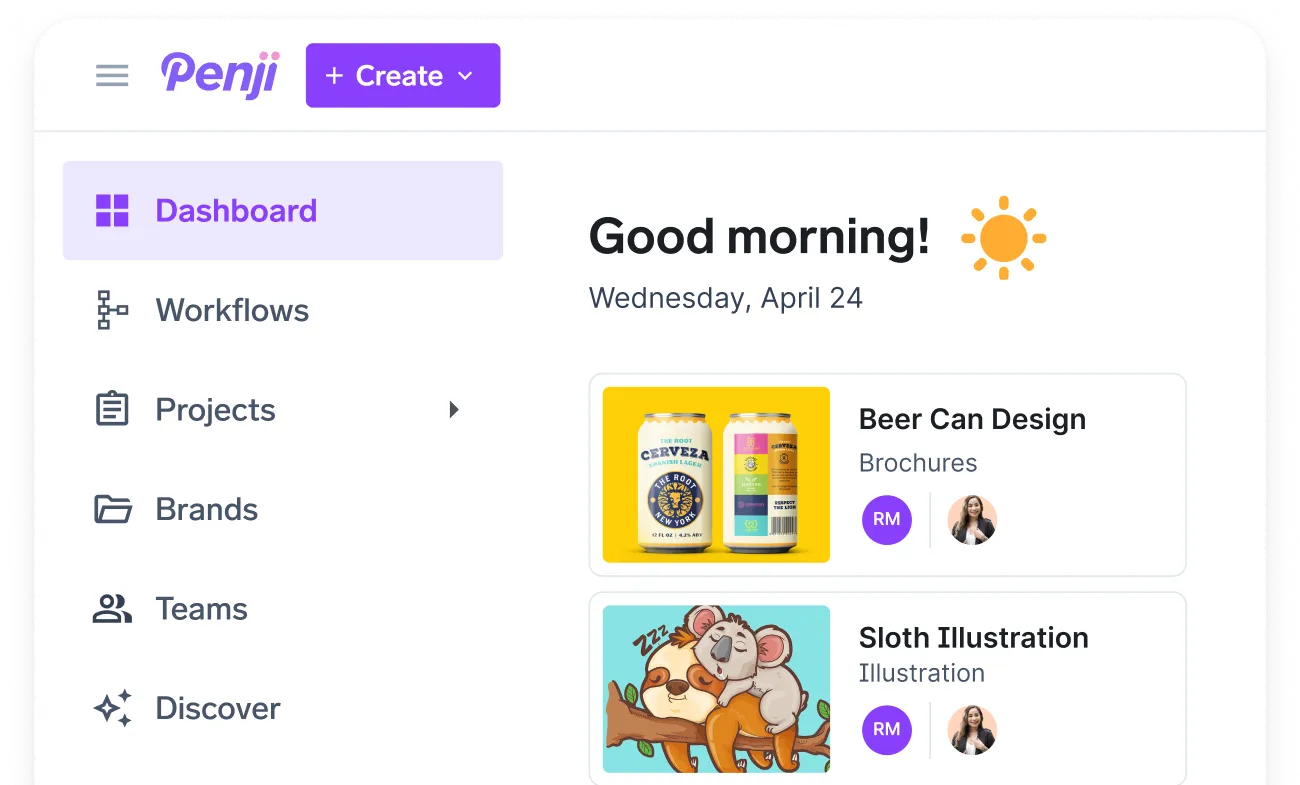
Clients submit requests through a structured dashboard, and designers work against established brand profiles so there’s no re-briefing on every project.
That’s how on demand graphic design at this scale stays consistent without sacrificing quality.
Professional design services by the world's top 1% designers
Unlimited graphic design at a flat monthly rate
How Does On Demand Graphic Design Change the Timeline?
Traditional design relationships are project-based. You hire someone, scope the work, negotiate timelines, and wait.
On demand graphic design flips that. You submit a request and work starts. No proposal stage, no contract negotiation, no scheduling delay.
This model works particularly well for marketing teams producing a consistent volume of assets: social graphics, ad variations, email headers, presentation decks, event materials. The pipeline stays open. The designer stays familiar with the brand. Work keeps moving.
That consistency matters more than most businesses realize. According to HubSpot research, consistent brand presentation can increase revenue by up to 33%.
That number doesn’t happen when design assets arrive late or vary in quality from week to week. Speed and brand consistency aren’t separate goals. They’re the same goal.
Penji’s unlimited graphic design services are built for exactly this kind of volume, with turnaround times that match a real publishing schedule.
What Should You Expect From Design as a Service?
Design as a service is a different way of thinking about creative support altogether. You’re not paying per project. You’re paying for continuous access to a professional designer who knows your brand and delivers on a predictable schedule.
The best design as a service providers hold themselves to defined turnaround commitments. For Penji, that’s 1 to 2 business days on most requests, with same-day revisions available on active projects. Compare that to the industry average for agency work, which typically runs 5 to 10 business days per asset once review cycles are factored in. The math isn’t close.
For businesses publishing content daily or managing seasonal campaigns, that gap is the difference between a strategy that executes and one that’s always one design behind.
Conclusion
Slow design is a business problem, not just a creative one. When campaigns wait on assets, momentum stalls. When revisions take days, opportunities close.
The benchmark that actually matters isn’t what the industry averages. It’s what your business needs to keep moving.
Most teams publishing at any real volume need design service turnaround under 48 hours, and that’s a bar only a handful of providers consistently clear. Penji is one of them.
See what Penji can do for your brand. Browse plans and get started today.
Frequently Asked Questions
For simple assets like social graphics, display ads, or email headers, a reasonable design service turnaround is 24 to 48 hours. More complex projects involving brand identity, multi-page documents, or custom illustration typically take 3 to 7 business days. If your current provider regularly exceeds those windows, it’s worth evaluating whether the setup still fits your output volume.
Penji typically delivers within 1 to 2 business days for most requests, while freelancers commonly quote 3 to 7 days depending on their workload. The difference comes down to structure. Penji assigns a dedicated designer to each client account and operates within a defined queue system, which removes the scheduling uncertainty that comes with freelance work.
Not when the speed comes from a better workflow rather than rushed execution. Providers that build clear intake systems, maintain brand profiles for each client, and assign consistent designers can deliver fast without sacrificing quality. Turnaround time and quality are separate variables. The right setup optimizes for both.
Design as a service works best for businesses with recurring, high-volume design needs: e-commerce brands, marketing teams, content creators, and growing startups that produce assets on a regular schedule. If your design needs are infrequent or highly specialized, a project-based agency might serve you better. But for anyone publishing content consistently, a subscription model typically outperforms the alternatives on both speed and cost.
About the author

Flore
Flore’s passionate about turning ideas into clear, useful content that connects with people and performs on search. From blog posts and landing pages to full content plans, her work is grounded in purpose and always aligned with a bigger picture.
Table of Contents
- What Do Industry Benchmarks Say About Design Service Turnaround?
- Why Does Design Service Turnaround Vary So Much?
- What Makes Fast Turnaround Design Services Actually Fast?
- How Does On Demand Graphic Design Change the Timeline?
- What Should You Expect From Design as a Service?
- Conclusion
- Frequently Asked Questions